
Gasoil & Diesel
Gasoil — known commercially as diesel — is the middle distillate that powers road transport, marine engines, generating sets, mining fleets and agricultural machinery. Its commercial value rests on four properties: sulphur content, cetane number, cold-flow behaviour and cleanliness. IFENERGY supplies the full sulphur ladder from 10 ppm ULSD down to high-sulphur industrial grades, each with an independent certificate of analysis.
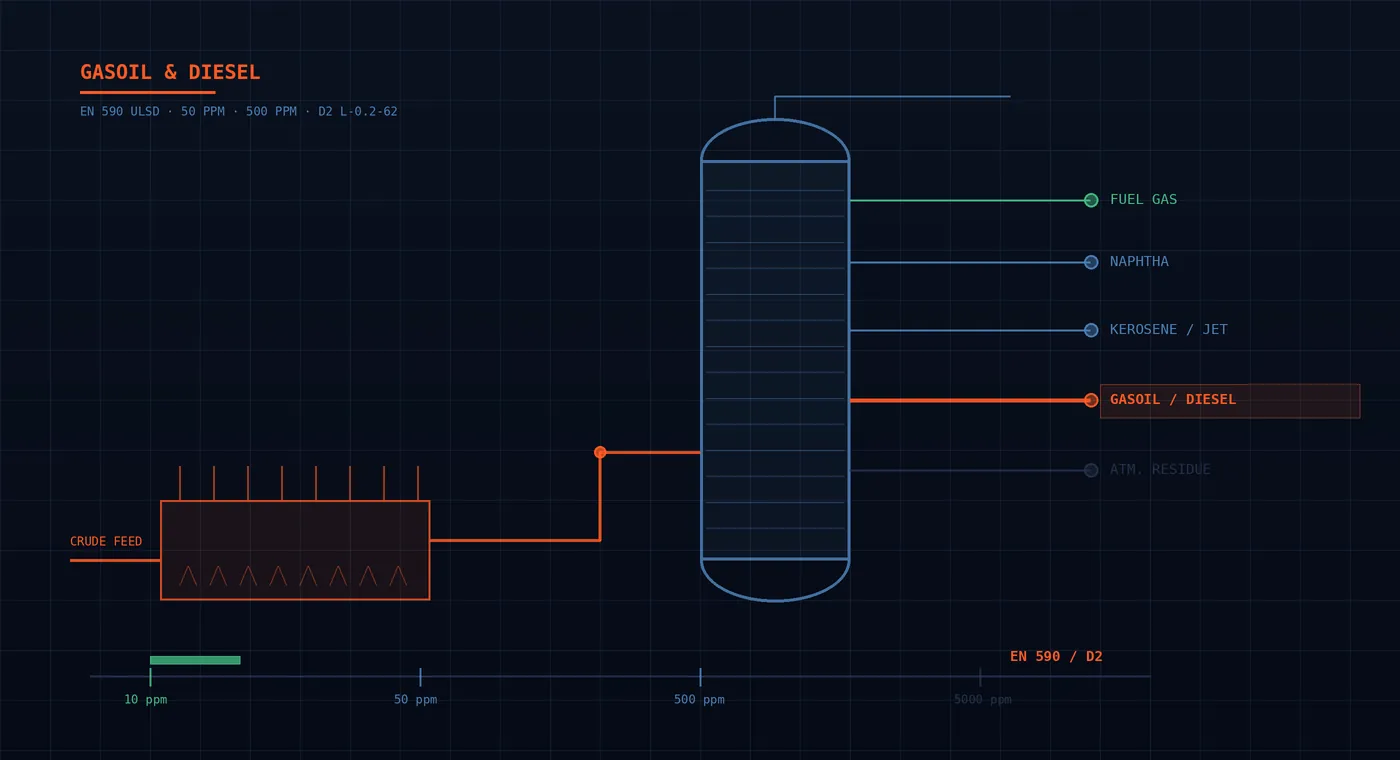
01Reading a diesel specification
Sulphur. EN 590 requires ≤ 10 mg/kg for road use in Europe; 50 ppm (Euro IV) and 500 ppm remain common for off-road, marine and power-generation markets. Lower sulphur protects after-treatment systems but reduces natural lubricity, so lubricity improvers are dosed to keep HFRR wear below 460 µm.
Cetane. The cetane number measures ignition delay: a minimum of 51 is required by EN 590, while D2 gasoil is typically 45–50. Higher cetane means smoother combustion, easier cold starting and lower NOx.
Cold flow. Cloud point, pour point and CFPP determine the lowest ambient temperature at which the fuel will still pass a filter. Winter grades are treated with flow improvers or blended with kerosene to reach CFPP values down to −20 °C.
Cleanliness and stability. Water content, total contamination, oxidation stability and copper-strip corrosion govern storage life and injector health — critical for cargoes that will sit in tank for months.
02Key Advantages
- Full sulphur ladder: 10 ppm, 50 ppm, 500 ppm and 5,000 ppm
- Winter and summer grades with tailored CFPP
- Cargo sizes from a single ISO tank to full MR parcels
- Independent SGS analysis before and after loading
- Storage and blending at Fujairah, Jebel Ali, Rotterdam and Houston hubs
03Applications
- Road transport fleets and logistics operators
- Power generation and standby generating sets
- Marine auxiliary engines and inland vessels
- Mining, construction and agricultural machinery
- Industrial burners and process heating
04Technical Features
- EN 590 automotive diesel with ≤ 10 mg/kg sulphur
- D2 gasoil L-0.2-62 (GOST 305) for industrial markets
- Cetane index and cetane number certified per batch
- Lubricity improved to HFRR ≤ 460 µm
- FAME-free or B7 biodiesel blends on request
- Dyed or undyed as required by destination regulations
05Typical Specification & Analysis
Indicative values — a batch-specific certificate of analysis is issued for every consignment.
| Parameter | Typical Value | Test Method |
|---|---|---|
| Density @ 15 °C | 820 – 845 kg/m³ | EN ISO 12185 |
| Sulphur content | ≤ 10 mg/kg | EN ISO 20846 |
| Cetane number | ≥ 51 | ASTM D613 |
| Cetane index | ≥ 46 | EN ISO 4264 |
| Flash point | ≥ 55 °C | ASTM D93 |
| Kinematic viscosity @ 40 °C | 2.0 – 4.5 mm²/s | ASTM D445 |
| CFPP (winter grade) | −5 to −20 °C | EN 116 |
| Water content | ≤ 200 mg/kg | EN ISO 12937 |
| Total contamination | ≤ 24 mg/kg | EN 12662 |
| Ash content | ≤ 0.01 wt % | EN ISO 6245 |
| Carbon residue (10 % btms) | ≤ 0.30 wt % | EN ISO 10370 |
| Copper strip corrosion (3 h, 50 °C) | Class 1 | ASTM D130 |
| Lubricity, HFRR wear scar @ 60 °C | ≤ 460 µm | EN ISO 12156-1 |
| Oxidation stability | ≤ 25 g/m³ | EN ISO 12205 |
| Colour | ≤ 2.0 ASTM | ASTM D1500 |
| Distillation, 95 % recovered | ≤ 360 °C | ASTM D86 |
06Delivery & Shipping Options
We deliver worldwide under Incoterms 2020 (FOB, CFR, CIF, DAP), with full documentation, third-party inspection and flexible packing.
Clean-product tankers
MR (35–45,000 MT) and Handy parcels with segregated, coated tanks and prior-cargo approval.
ISO tanks & flexitanks
20 ft ISO tanks of 24–26 MT and flexitanks of 20–24 MT for smaller or landlocked destinations.
Drums & IBC
200 L steel drums (80 per 20' container) and 1,000 L IBCs for project and retail volumes.
Road & rail
30–40 MT road tankers and rail tank cars for regional overland delivery.
Related Services
Crude Oil
Light, medium and heavy crude grades — sweet and sour — supplied FOB, CFR and CIF worldwide.
Read moreBitumen
Penetration, viscosity, oxidised, cutback and emulsion grades in drums, jumbo bags and bulk.
Read morePetroleum Derivatives
Base oils, fuel oil, naphtha, LPG, paraffin wax, sulphur, urea, solvents and aromatics.
Read more